When comparing tretinoin creams, the percentage on the package is an easy place to start. The scientific question is more demanding: what evidence connects the complete preparation with the particular result a reader wants? Answering it requires identifying the comparator, the people observed and the measurement used. These details determine the claim an experiment can support.
This article follows that chain from product identity to a decision between formulations. It separates the research findings from our methodological interpretation and uses explicitly invented examples to explain difficult comparisons. Those examples are teaching tools, not estimates of what anyone should expect from treatment. The aim is a better evidence question, rather than a concentration ranking.
Study figure and data
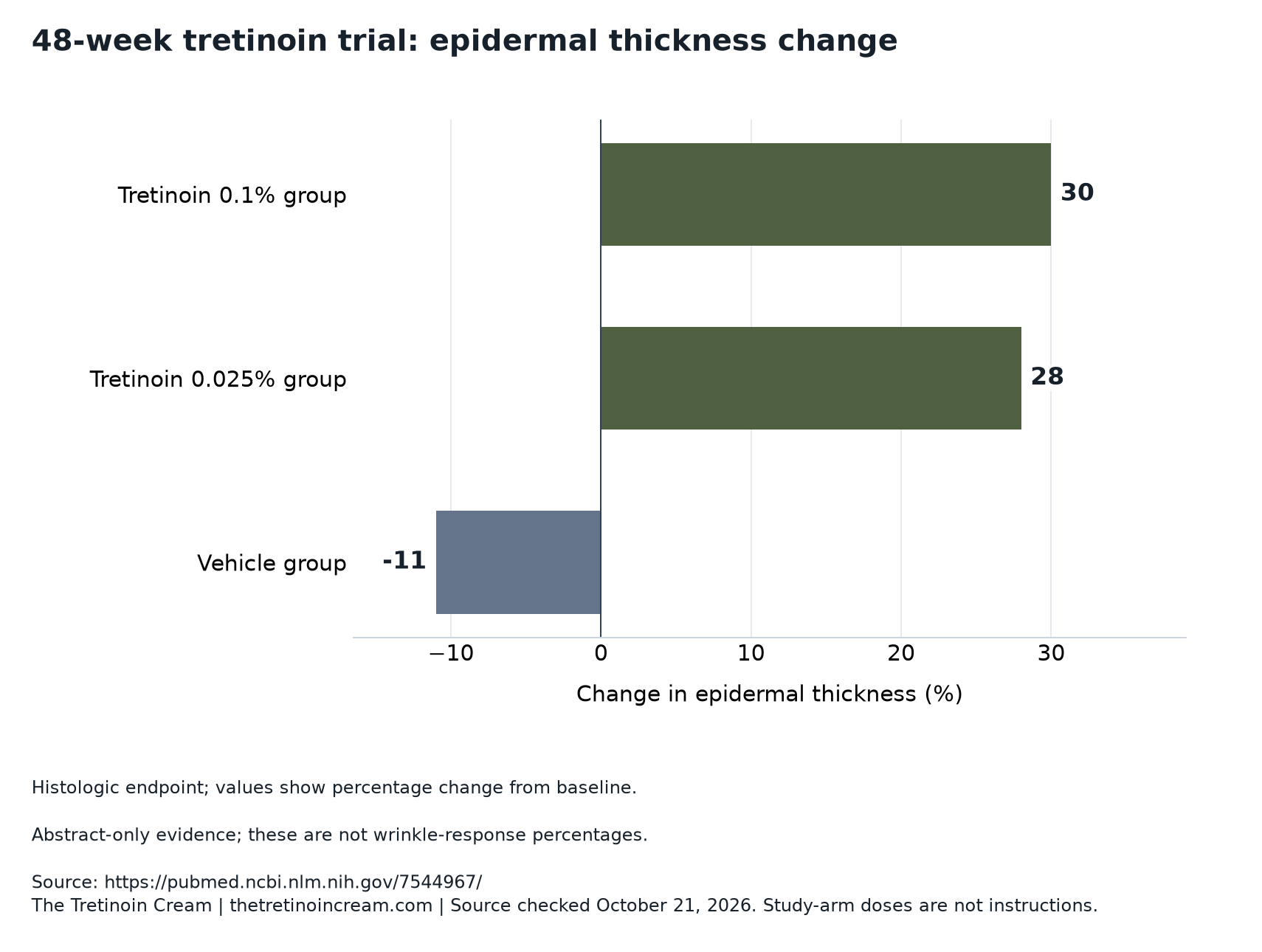
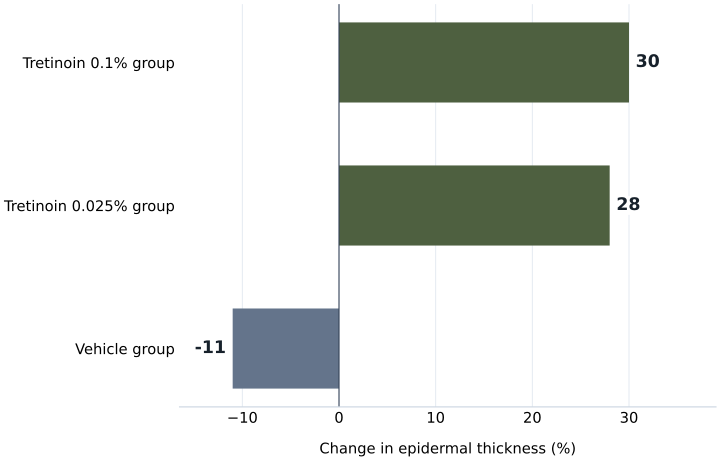
Histologic endpoint; values show percentage change from baseline.
Abstract-only evidence; these are not wrinkle-response percentages.
Download source-labeled chart (PNG)Download chart data (CSV)Download vector chart (SVG)
| Study group | Reported value |
|---|---|
| Tretinoin 0.1% group | 30 |
| Tretinoin 0.025% group | 28 |
| Vehicle group | -11 |
Sections in this article
Start with the preparation being compared
A cream comparison needs a precise object: the preparation applied, its comparator and the outcome being sought. An ingredient percentage identifies one feature of that object. It does not describe the entire experiment. As an editorial way to organize a product document, write the active ingredient, base, additional ingredients and intended use on separate lines. Then ask which lines are actually supported by a comparative study.
Imagine two fictional creams with the same ingredient percentage but different bases. If their outcomes differed, the percentage alone would not explain the difference. Now imagine changing both the percentage and the base between preparations. Even a well-conducted comparison would evaluate those finished preparations together; separating the contribution of each changed feature would require another design. This is a question about what an experiment can identify, not a claim that either fictional cream works better.
Our guide to custom creams and standard products offers a place to organize those identity questions. Treat an unresolved ingredient or formulation detail as a specific missing item. Avoid filling that space with an assumption that every product containing the same named active has already undergone the same evaluation.
Keep the participant record attached to the result
In 1995, 99 people with facial photoaging completed 48 weeks: 0.1% tretinoin cream (32), 0.025% (35), or vehicle (32). Both improved clinical assessments versus vehicle, without a significant active-arm difference; higher-strength redness and scaling were greater. The abstract does not establish randomization, enrollment, attrition, funding, confidence intervals or formal equivalence.
A completer count tells readers which people reached the stated end of observation. To understand selection, a separate record would show who entered, what happened afterward and which observations contributed to each analysis. The logical point is not that any particular number must be missing. It is that a final count cannot reconstruct the earlier flow by itself. Masking and allocation answer separate design questions: who knew a treatment’s identity, and how a person came to receive it. A documented answer to one does not supply the answer to the other.
For a reusable reading record, give participant flow and assignment their own spaces beside the result. This prevents an attractive conclusion from silently acquiring a stronger design description during retelling. The trial-reading guide develops that habit: identify what each document establishes before deciding how much weight its comparison deserves.
Ask what the vehicle comparison subtracts
A vehicle is the preparation used as the comparison base without the study active. The question of interest is the difference between treatments under their shared study conditions. A before-and-after change in one group answers a narrower question. It does not, by itself, tell us how much change would have occurred with the comparison preparation and the rest of the study routine.
Consider an invented example using an arbitrary appearance scale. A test cream improves by three points and its comparison base improves by one point. The difference in changes is two points. Crediting all three points to the added active would ignore the observed comparator change. Calling the base useless would also misdescribe this hypothetical record. None of these numbers comes from the tretinoin research, and the example supplies no prediction about a real cream.
An informative comparison would also document whether the preparations were otherwise matched and whether other care was comparable. If several features changed together, interpretation should remain at the level of the whole tested package. The cream-versus-lotion guide can help readers list these formulation questions without deciding the answer from the dosage-form name alone.
| Comparison question | Evidence to look for | Inference to avoid |
|---|---|---|
| Change from baseline | Outcome before and after the same treatment | Attributing the entire change to one ingredient |
| Added contribution | Active preparation and an appropriate vehicle comparator | Treating a vehicle as the absence of all care |
| Choice between products | Direct comparison of the finished preparations | Assigning a difference to percentage when several features changed |
| Credible masking | Description of who remained unaware of assignment | Assuming a masking label proves identical experiences |
Preserve the units of each measurement
The plotted results describe tissue, not wrinkle percentages. That distinction concerns the meaning of the measurement, even before considering how accurately it was obtained. A result should retain its original outcome name when it moves from a research table to a graph, a summary or a product discussion.
For illustration, invent a tissue measurement that rises from eight to ten units. The relative increase is one quarter of the starting value. That arithmetic says nothing about how many people notice a cosmetic change, how much a facial rating changes or whether a person considers the difference worthwhile. Those are other measurements. Converting between them would require evidence connecting the specific measurements, rather than a more persuasive description of the same percentage.
Repeatability and relevance are also different questions. Repeated readings of an unchanged sample could be tightly clustered, yet the measurement might remain poorly suited to the decision a reader faces. Conversely, a meaningful appearance outcome could be recorded imprecisely. A strong evaluation would describe the measurement procedure, the variation between readings and the reason that this outcome helps answer the intended clinical question.
Separate a detectable difference from a useful margin
Comparing two active preparations calls for more than checking whether each differs from its vehicle. The useful question is their direct contrast and how precisely it is estimated. A significance test asks whether the observed evidence meets a specified statistical criterion. A decision about practical similarity asks whether the uncertainty is small enough to exclude differences that matter.
Here is an invented illustration, unrelated to the study measurements. Suppose a comparison has a difference estimate near zero, with an uncertainty interval from minus three to plus one and a half units. If differences outside minus two to plus two units would matter, that interval still allows a meaningful disadvantage in one direction. An interval from minus one half to plus one half would address the proposed margin more closely. Neither example sets a clinically accepted margin for tretinoin.
For a formal equivalence argument, the margin needs a defensible rationale and a suitable analysis, not a choice made after seeing a convenient result. A claim of equivalence should therefore be checked against that fuller design record. The strength-and-tolerability guide extends the decision question: what advantage is being sought, and what evidence would be sufficient to distinguish the available options?
Give irritation its own outcome record
An appearance assessment and an irritation assessment answer different questions. Treating discomfort as a substitute measure of benefit would collapse them into one. For a proposed formulation comparison, record the desired outcome and unwanted effects separately before discussing their balance. That makes it possible to ask whether an apparent advantage is accompanied by an acceptable, unacceptable or still uncertain burden.
The burden itself needs definition. An invented example illustrates why: two hypothetical participants could each have one recorded reaction, but one experiences a brief mild symptom while the other has prolonged discomfort that disrupts participation. Counting one event for each person loses that difference. Severity, duration, recurrence and consequences for participation provide distinct information; they should not be mixed into an unlabeled total.
A relationship between symptoms and appearance change would also need its own analysis. Seeing both in the same person would not establish that one produced the other. An alternative explanation could involve a shared cause or differences in exposure. Our irritation and follow-up guide is a place to prepare a symptom account for a clinician. This methodological discussion does not prescribe a frequency or tell someone to continue through a reaction.
Specify the decision the analysis should answer
Before designing a comparison, decide whether the target is performance among people who persist with a preparation or the experience of everyone initially assigned to it. Those questions can require different analyses. A product choice usually includes the possibility that someone cannot continue, whereas a narrower biological question might focus on a defined exposure. Neither question should be smuggled in after examining which analysis looks most favorable.
In a hypothetical formulation study, removing everyone who found a cream difficult to use could leave an especially tolerant group. Reporting only that group would describe its observed experience, not automatically the experience of future users. On the other hand, treating every missing observation as failure would impose another assumption. A transparent report would show who contributed data and explain how conclusions change under plausible alternatives.
This is an editorial reason to separate research evidence from practical product documentation. A reader using the Nurx review to examine documents can make a list of unresolved formula and follow-up questions. That link is not a statement that a provider uses a trial preparation. The evidence task remains to match the actual decision with an analysis capable of answering it.
Use duration to sharpen the question
The 2005 randomized trial studied 204 people with moderate-to-severe facial photodamage, comparing 0.05% tretinoin emollient cream with vehicle for up to two years. Its indexed abstract reports better clinical assessments, a procollagen marker increase and no increase in selected histologic abnormalities; numerical clinical effect sizes are absent. OrthoNeutrogena supported the study; publisher disclosures identify Johnson & Johnson employment and equity ties, research support, and pharmaceutical trial or consulting relationships among authors.
A longer observation period makes time part of the comparison rather than a decorative descriptor. An evaluation could ask when a difference appears, whether its size changes, and how many people still contribute observations at each visit. A single endpoint cannot reconstruct every earlier trajectory. Likewise, two preparations assessed at different times do not become a direct comparison merely because the longer study sounds more comprehensive.
Biological markers add another layer. A marker can motivate a hypothesis about what might happen next, but the next event remains a separate outcome requiring measurement. An argument about preventing injury or disease would need evidence about those events, suitable follow-up and an appropriate comparator. More observation time does not transform one kind of endpoint into another. For a finished cream, the relevant question is which specific claim has become better supported, not whether the study has acquired an unrestricted stamp of safety.
Build a bridge before transferring a finding
A 2007 randomized, paired-arm study used laboratory 0.4% retinol lotion versus vehicle in 36 adults averaging 87 years, with 23 completing 24 weeks. It assessed fine-wrinkle scores on protected upper arms. Three participants withdrew because of irritation or related symptoms. Four investigators disclosed conditional patent royalties; payments received and a funding sponsor were not established.
Transporting evidence means arguing that a result is relevant beyond the setting in which it was measured. That argument should identify the change being made: preparation, ingredient, population, skin location or outcome. If several change at once, a convenient shared category name cannot establish that the result will stay the same. This is a question about the proposed inference, not a claim that an untested preparation has no effect.
The companion retinol formulation and paired-study analysis examines the different experiment in detail. For comparison planning, an explicit bridge would ask what needs to be held constant and what additional evidence would test the transfer. Two independent vehicle comparisons do not, on their own, estimate a difference between the active products. A reader should be able to identify the extra assumption required before combining their conclusions.
Assemble the evidence needed for a product choice
The current RENOVA 0.02% label limits its indication to mitigation of fine facial wrinkles alongside comprehensive skin care and sunlight avoidance. It does not claim reversal of photoaging. It warns against use during pregnancy or when attempting pregnancy, and identifies local irritation and increased sunburn susceptibility.
Labeling and research serve different roles in a decision file. One identifies the authorized product information being consulted; the other addresses a particular experiment. Keeping separate spaces for those documents prevents a research result from rewriting a different preparation’s label. A useful file would retain the precise formulation identity, the proposed benefit and the evidence connecting that identity to that benefit.
For readers opening the Musely review, the editorial purpose is to identify documents and questions to verify, without inferring a match to these study preparations. Choosing between finished creams would be better informed by direct comparative evidence, a meaningful outcome, adequately described uncertainty and a separate account of harms. Where that evidence is incomplete, write the unresolved question explicitly. That is more useful than turning a percentage into a universal ranking or treating every uncertainty as a reason that no comparison is possible.
| Decision element | Document or analysis needed | Question it would answer |
|---|---|---|
| Preparation identity | Full description of the products actually compared | Does the research concern these preparations? |
| Meaningful benefit | Defined clinical outcome and justified interpretation | What difference would matter to the intended user? |
| Comparative precision | Direct contrast with an uncertainty interval | Which important differences remain plausible? |
| Burden of treatment | Separate symptom, interruption and discontinuation records | What did participation involve beyond the desired outcome? |
| Relevance to another setting | Explicit assessment of changed conditions | What assumptions are needed to apply the result elsewhere? |
Questions about the evidence
How should I compare two product percentages?
First state the question the comparison is meant to answer. For example, is it a difference in a defined clinical outcome, a particular unwanted effect or the experience of using the whole preparation? Then look for evidence about those products and that question. A number describing composition cannot supply the missing comparison.
What would a convincing similarity claim need?
It would need a justified definition of how close the outcomes must be, a design and analysis suited to that claim, and enough precision to address the chosen margin. A result that merely fails to cross a significance threshold answers a different statistical question. The relevant uncertainty should remain visible.
How can a graph exaggerate the meaning of a result?
A graph can preserve every number while replacing the measured outcome with a more attractive claim in its title. To check it, match the axis, units and comparator to the actual measurement. Also ask whether the display distinguishes observations from estimates and uncertainty. Correct arithmetic alone does not establish a clinically meaningful interpretation.
What is the right way to compare reactions?
Use the same definition and observation period for each preparation, and separate people affected from events recorded. Then examine severity, duration and consequences for participation. A single overall reaction count can hide very different experiences. This is a framework for reading evidence; personal symptoms belong in a discussion with the prescribing clinician.
Which product documents are most useful to gather?
Gather the actual product information, a clear description of the proposed formulation and the research cited for the specific outcome. Put unanswered questions beside the relevant document rather than substituting a review score. A clinician can then address the personal decision with the correct product identity and the limits of the comparison in view.
Editorial assessment
Our interpretation is that a useful cream comparison begins with a testable claim about a defined preparation. The next steps are to identify the comparator, preserve the measured outcome and ask whether the uncertainty is narrow enough for the decision. Desired effects and unwanted effects deserve separate records. The strongest next piece of evidence is therefore not necessarily another general statement about an ingredient; it is the study or product document that resolves the specific gap between the preparation being considered and the outcome being claimed.
Research access and limitations
Access: the 1995 indexed abstract; the 2005 indexed abstract and publisher disclosures; the full 2007 publisher article; and current RENOVA labeling. No participant-level reanalysis is presented. Explicitly invented examples explain inference and do not estimate treatment effects. Research exposure descriptions are not personal instructions.
Sources and access notes
Sources checked October 22, 2026. Access notes identify the material examined for this article.
- Two concentrations of topical tretinoin (retinoic acid) cause similar improvement of photoaging but different degrees of irritation. A double-blind, vehicle-controlled comparison of 0.1% and 0.025% tretinoin creams.
Indexed original research abstract · Checked October 21, 2026
- DailyMed - RENOVA- tretinoin cream
Official current labeling retrieved in full · Checked October 21, 2026
- Long-term efficacy and safety of tretinoin emollient cream 0.05% in the treatment of photodamaged facial skin: a two-year, randomized, placebo-controlled trial.
Indexed original research abstract plus publisher acknowledgment and financial disclosures; full methods and results not reviewed. · Checked October 22, 2026
- Improvement of naturally aged skin with vitamin A (retinol).
Full publisher research article, including original clinical table-image footnote, figure captions, Comment and Financial Disclosure; no supplements or individual data reviewed. · Checked October 21, 2026